
Monday Manna - God Doesn't Need Good Soil

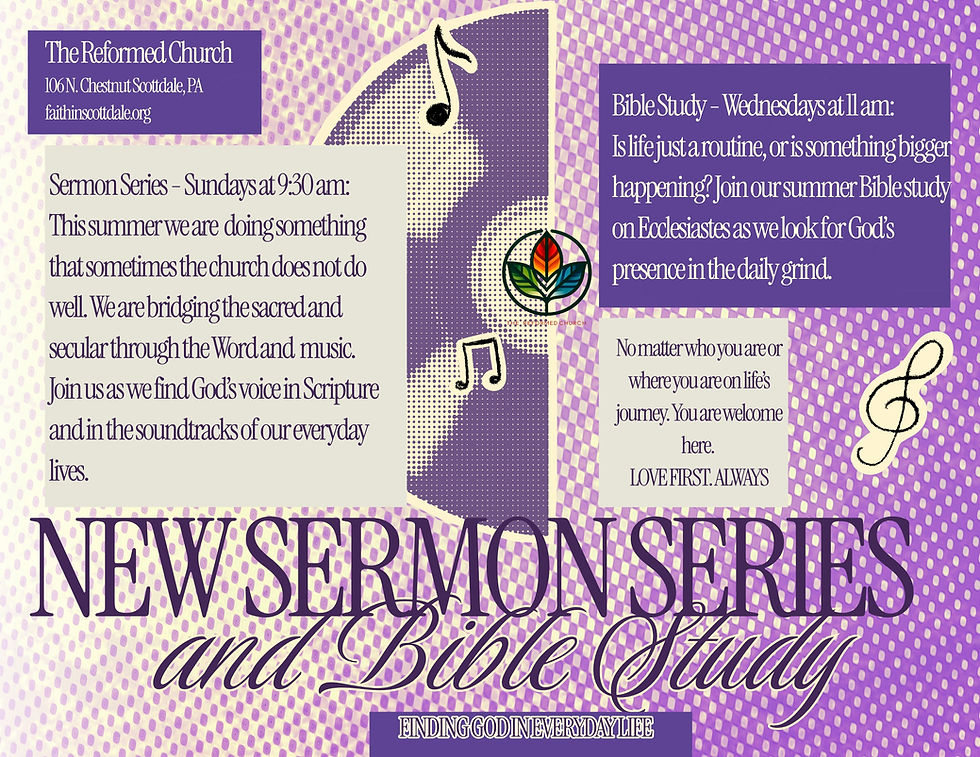
This past Sunday we continued our sermon series on finding God in the secular. To be completely honest, some of the imagery and language in "Jesus Walks"—which is mild compared to most rap music—made me a little hesitant to play it. But I decided to run it right before worship started anyway, right here in the fellowship hall where we’ve been gathering to stay cool for the summer. We reflected on a few tough questions about it and shared a bit during our witness and wonder moment. Just a quick heads-up to anyone watching online: during this series, we have to be careful with sharing these music videos because of copyright laws. Our livestream audio will get muted during those clips, so coming out to the service in person or watching live is the best way to not miss out.
I wanted us to look at this because rap music didn't start out the way you hear it on the radio. It was co-opted. What began as a community’s raw expression of the Black experience, a way of lamenting pain and warning each other about the dangers outside the front door, got commodified by wealthy record executives who realized drugs, sex, and violence sell. But Kanye West defied those labels when they warned him a song heavy with the Gospel would never get radio play. He did it anyway, and "Jesus Walks" became one of the defining songs of 2004 because it spoke the Gospel directly into the culture of his people. It also spoke a radical forgiveness to his community by looking at someone society deems totally unredeemable—a KKK member. In the video, a man in a white hood builds a wooden cross and sets it ablaze on a hillside. But the wind catches it, it tumbles out of his control, and the flames catch his own robe. Just as he's about to be consumed by his own hatred, the sky opens up and a torrential rain pours down, soaking him and saving him. Jesus didn't wait for him to take the robe off first.
That reckless grace is exactly how God deals with the generational trauma and harm we inherit and inflict on each other. Look at Rebekah’s womb—Jacob and Esau were literally at war before they were even born, carrying the unresolved grief of Abraham and Isaac’s long silence right into their DNA. We carry those same generational chains. But God doesn't wait for our soil to be right, or for our families to get their act together before He moves. In fact, there's a section of the text the lectionary completely skips over where the disciples stop Jesus and ask why He keeps teaching in these cryptic parables. He tells them it’s because we have to have the eyes to see and the ears to hear. Jesus was speaking in code, much like the African American spirituals did. Think about "Wade in the Water," the song we listened to. To the slave owners, it just sounded like a pretty church melody. But to the people running for their lives, it was a literal, survivalist map telling them to get into the river so the tracking dogs would lose their scent. That is why our faith is not meant to be a spoon-fed one; it is a truth wrapped in something that must be actively planted, tended, and grown deep within us.
It reminds me of a time my pastor asked how I'd teach this parable to urban youth who have never experienced gardening to relate to the imagery. I thought of the graffiti artist Mook here in Pittsburgh. Where he chose to tag changed the whole meaning and longevity of the message, and that’s what the Sower does—He tags the impossible places. We’ve treated the Parable of the Sower like a permanent spiritual report card, but the soil changes with us. Your heart goes through seasons. Throughout your life, you will receive God’s word and love differently and with different results depending on the weather of your soul. God sows anyway, completely unbound by the quality of your dirt, until something deep finally takes root and becomes fruitful. The soil was never the point. Your soul is.
Kick off your week with the Word of God through our weekly spiritual practice of Dwelling in the Word:
The Four Movements of Lectio Divina AKA Dwelling in the Word
Taking time to slow down and simply dwell in the Word is one of the most life-giving rhythms we can cultivate. In a world that constantly demands we read for information or efficiency, this spiritual practice invites us to read for intimacy and transformation. It is about letting the text master us, rather than us trying to master the text.
Here is a simple, four-step guide to help you sit with the Scriptures, followed by brief, clear summaries of the passages you've selected to guide your reflection.
Before you begin, find a quiet space, take a few deep breaths, and invite the Holy Spirit to speak.
1. Lectio (Read): Read the passage slowly, gently, and preferably aloud. Don't rush to finish. Just listen for a single word, phrase, or image that seems to shimmer or catch your attention.
2. Meditatio (Reflect): Read the passage a second time. Take that specific word or phrase and chew on it. Why did the Spirit highlight this for you today? How does it intersect with your current joys, burdens, or questions?
3. Oratio (Respond): Read the passage a third time. Now, turn your reflections into an honest prayer. Talk to God as you would a trusted friend — pour out your gratitude, your doubts, your requests, or your repentance based on what the text stirred up.
4. Contemplatio (Rest): Read the passage one final time. Release all your thoughts and simply rest silently in God's presence, letting His love wash over you like a deep exhale.
Scripture Summaries for Reflection This Week
Use these one-line summaries of the text to pick which scripture you will dwell in each day of this week. I have found staying in one scripture for a longer period of time can draw out more than bouncing between several. These are from the Revised Common Lectionary. You can read them in full all together here.
Genesis 28:10-19a: Jacob falls asleep on a hard rock in the middle of nowhere and wakes up to realize that God was in that ordinary, secular place all along—he just didn't know it.
Psalm 139:1-12, 23-24: There is absolutely nowhere we can run, no dark corner or distant horizon, where God’s presence won't actively track us down and find us.
Wisdom of Solomon 12:13, 16-19: Even though God holds all the power in the universe, He chooses to master His own strength and deal with our mess through radical clemency and kindness.
Isaiah 44:6-8: God looks at a world full of cultural idols and reminds us that He is the only true anchor from the very beginning to the very end—so we don't need to be afraid.
Psalm 86:11-17: A raw, honest prayer for when our hearts feel divided, asking God to patch up our internal fractures and show us a sign of His stubborn favor.
Romans 8:12-25: We aren't meant to live as slaves to our old anxieties and traumas anymore; we are adopted children, groaning right along with the rest of creation for the full healing that's coming.
Matthew 13:24-30, 36-43: Jesus reminds us that the world is a messy field where the good seed and the weeds grow up right next to each other, and it’s not our job to violently rip things out before the harvest is ready.


Comments